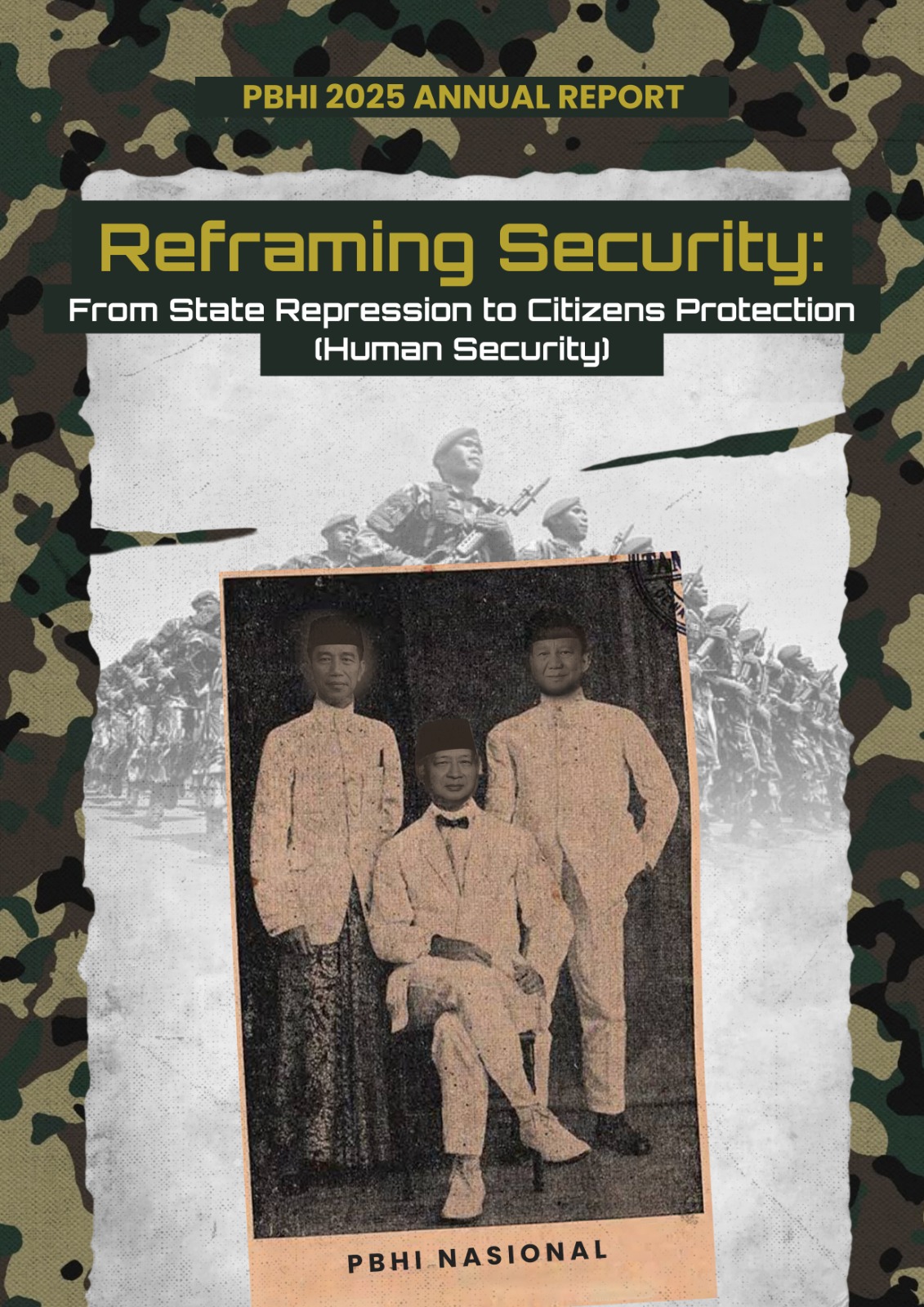
Prabowo Subianto, a former member of the Tim Mawar (Team Rose) unit, became president through a direct electoral process born out of the Reformasi era. His victory appeared to promise renewal through flagship programs such as the Free Nutritious Meals and the Red-and-White Cooperative. In reality, however, these developments have proven to be a nightmare.
PBHI anticipated this regression from the outset. Signs of democratic backsliding were predictable, starting from the intensification of securitization approaches through the expanding involvement of the Indonesian Military (TNI) in civilian domains, all the way to intelligence operations aimed at weakening civil society movements.
The closure of democratic space became apparent in the first year of the Prabowo-Gibran administration. Within a single year in office, 5,538 individuals were recorded as victims of violence perpetrated by security apparatuses during peaceful mass demonstrations opposing the ratification of the TNI Law, demanding labor welfare protections, and rejecting increases in lawmakers’ allowances.
Meanwhile, the revision of the TNI Law was passed within only 20 working days without meaningful public consultation. Oversight institutions were even targeted for weakening, as evidenced by the dissolution of the Papua desk and the stagnation of investigations into past gross human rights violations.
The regime has also consolidated power by co-opting opposition figures into government positions and distributing mining concessions to various mass organizations. At the same time, the regime further marginalized critical figures and groups. As a result, opposition forces are fragmented and nearly non-existent.
Indonesia’s 2024-2025 policy trajectory became clearer, in which we are now seeing a shift from consensual hegemony toward repressive domination. This shift was first visible in how the state drafted regulations. It was then followed by political elites consolidation across all branches of government (executive, judicial, and legislative). As documented by the civil society coalition for security sector reform, the TNI Law revision was completed by the House of Representatives (DPR) in merely 20 working days without public hearings involving civil society.
This entire sequence of developments aimed to push human rights back to their weakest point by institutionalizing security apparatus repression within regulatory frameworks.
One example lies in the revision of the TNI Law, which expands the scope of Military Operations Other Than War (OMSP) from 14 to 16 tasks. These include “empowering defense territories and the supporting forces from the outset in accordance with the universal defense system,” and “assisting in addressing cyber threats.”
The first phrase potentially opens the door for the recruitment of vigilante mass organizations as “supporting civilian forces” for domestic security operations, which was already legitimized under Law No. 23 of 2019 on National Resource Management for State Defense.
Restrictions on cyberspace have likewise intensified through enforcement measures, blocking and throttling access under the pretext of national security. The government previously employed similar tactics in 2019 to suppress protests in Papua. Current legislative discussions on the Cyber Security and Resilience Bill and the Surveillance Bill further indicate the government’s intent to narrow civic space online.
This expansion of authority is not merely administrative. It must be understood as a securitization strategy, which is transforming political issues into security threats. Narratives such as “a strong state ensures a safe people” and “TNI is strong together with the people” serve to legitimize repression under the guise of defending the state from “radicalism and separatism threats.” By framing labor protests, farmers’ demands, or journalistic criticism as “security threats,” the state justifies excessive force and the deployment of defense and security apparatuses.
PBHI strongly suspects intelligence involvement in the August 2025 protests. Civil society was deliberately weakened through engineered vertical divisions, scapegoating “anarchists” and foreign funding. Such divisions serve to perpetuate impunity, which in turn aligns with efforts to weaken oversight institutions such as the National Human Rights Commission (Komnas HAM), the Judicial Commission (Komisi Yudisial), and the National Police Commission (Kompolnas).
This structured legal impunity creates space for increasingly massive and systematic state violence. For democratic movements, this constitutes a clear attempt at silencing dissent. Elites can stabilize the order, even without genuine hegemony, if opposition forces are fragmented, divided, and passive.
It is time for civil society to unite and challenge this injustice. Not through frontal attacks that will be brutally repressed, but through sustained efforts to build collective awareness and strength across all elements of civil society.
A crisis of hegemony is both danger and opportunity. It is dangerous because fascism can grow under such conditions, as occurred in Germany under Hitler. Yet it is also an opportunity, because it means the old order is cracking, and space for alternatives has opened. Will Indonesia be trapped in a fragile and worsening authoritarianism, or will genuine democratization rooted in material justice emerge? The answer depends on the capacity of our resistance and our political imagination today. The 1998 Reformation opened the door to democracy, but that door is now being pushed shut. The question is whether we are strong enough to prevent it from being locked or even to open it wider.